

Stroud Water Research CenterLeaf Pack Network Home

Linking Trees to Streams

Historically, most small streams in the eastern United States were forested. Leaf fall from the forest canopy was the dominant food resource for small streams. All ecosystems rely on a steady supply of energy. Solar energy drives photosynthesis that supplies carbon (chemical energy) for the rest of the system. In many headwater streams, however, sunlight cannot reach the water's surface due to shading of the forest canopy. Therefore, most headwater streams rely on autumn leaf fall to supply much of the carbon needed to support the stream throughout the year.

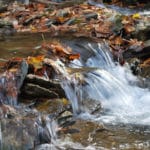
Natural leaf pack in a streamThe leaves that fall into streams accumulate in packs behind branches, rocks and other obstructions in the stream, forming natural leaf packs.

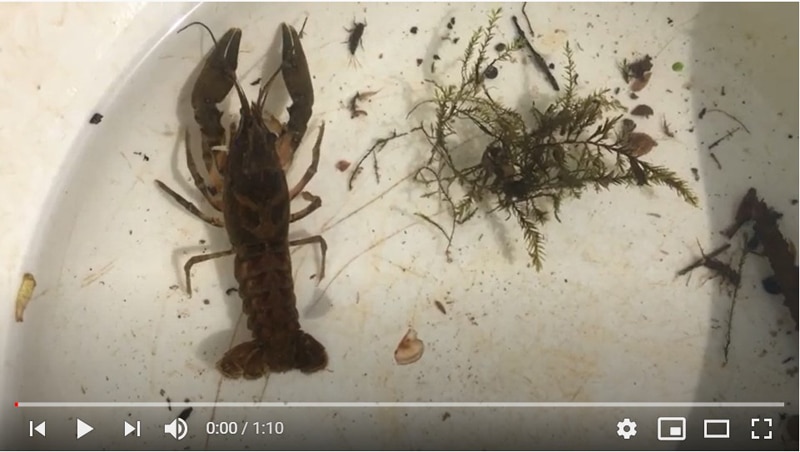
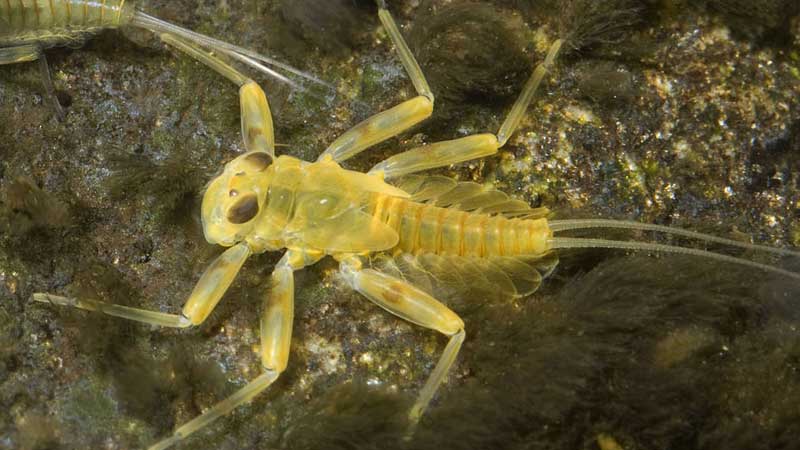
Leaves, falling in or near the stream, leach out organic molecules creating a "watershed tea" that flows downstream providing nourishment along the way. On the leaf surface, there is a diverse assemblage of microbes (fungi and bacteria) and macroinvertebrates (insect larvae, crustaceans, etc.) which "process" leaves and facilitate the flow of energy through the system. Macroinvertebrates are often referred to as "canaries of the stream" because they function as living barometers that indicate changes in water quality.

Benthic freshwater macroinvertebrates can be defined as the following:

Benthic = inhabit bottom areas/substrates
Freshwater = streams, rivers, lakes, ponds
Macro = relatively "large" (> 0.2-0.5mm)
Invertebrate = animal without vertebrae

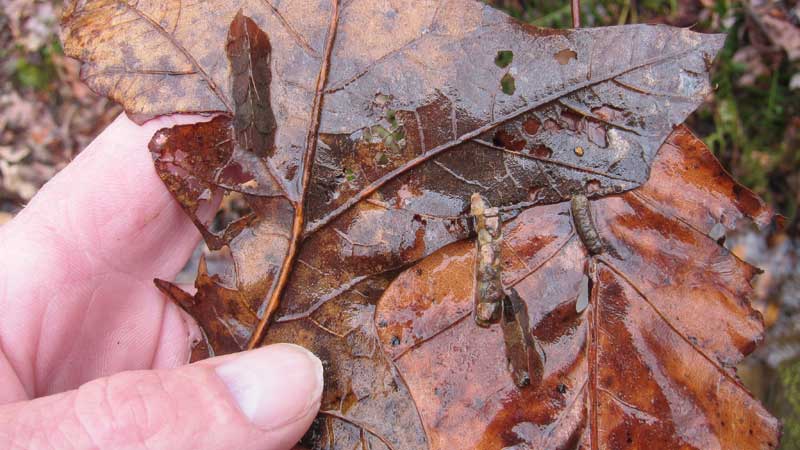
Maple leaf and cranefly larvae

Aquatic macroinvertebrates play important roles in the food webs of the stream ecosystem (Figure 1). Macroinvertebrates can be classified not only by traditional taxonomy but also by how they function in the ecosystem. This method of classification based on feeding adaptations and/or food preferences is known as functional feeding groups (Figure2).


Figure 1. Food web in small streams
Food web in small streams starting with 
sunlight and including microorganisms, epilithic algae, larger plants such as mosses and red algae, invertebrate scrapers, invertebrate predators, invertebrate collectors, invertebrate shredders, coarse 
particulate organic matter, dissolved organic matter, fine particulate organic matter, and vertebrate predators.
Food web in small streams
Image provided by, "Stream Corridor Restoration: Principles, Processes, and Practices, 10/98, by the Federal Interagency Stream Restoration Working Group (FISRWG)."


Figure 2. Functional Feeding Groups

Feeding Strategy Food Category
I. Shredders dead leaves/live macrophytes
II. Collectors fine organic particles (live/dead)
    filter feeders   particles in water column
    miners   buried particles
    browsers   bottom surface deposits
III. Scrapers live benthic algae (diatoms)
IV. Piercers live filamentous algae
V. Predators other invertebrates + small fish

Leaf fall from the forest canopy in small streams are used by shredders (Figure 3). Shredders get nutrition primarily from the fungi and bacteria that colonize the leaf surface. Craneflies, stoneflies, caddisflies and aquatic sow bugs are important members of this group. Small fragments of leaves and feces from shredders are captured by another group of macroinvertebrates called collectors. Netspinning caddisflies and blackflies are examples of this group.

Stream with natural leaf packs
Leaves accumulate in leaf packs in streams. The animals adapted to feeding on leaves are called "shredders."
Proportional chart of stream macroinvertebrates divided into shredders, collectors, grazers, predators, and microbes

Figure 3. Shredders and collectors
form the major proportion of stream macroinvertebrates.

As the stream widens, exposing more of the water's surface to sunlight, in-stream photosynthesis plays a more important role. Leaf litter reaching the stream decreases and algae, due to the increased sunlight, becomes more abundant. As the food base shifts so does the type of invertebrates. Grazers/Scrapers who utilize the abundant algal resource increase while shredders decrease (Figure 4). Snails, limpets, certain mayflies and case-building caddisflies are adapted to feeding on the algae growing on rock surfaces.

Collectors, grazers and scrapers make up the bulk of macroinvertebrates in a mid-sized stream

More sunlight reaches this mid-sized stream.

Figure 4. Collectors gather or filter plant fragments, feces, and plankton. Grazers, also known as Scrapers browse on algae.

Further downstream the river channel widens and deepens. Trees shade only the edge of the river and sunlight, although abundant, does not penetrate to the river's bottom due to turbidity. The food base is dominated by phytoplankton and fine, suspended organic particles generated further upstream and from the river's floodplain. Filtering collectors (Figure 5) such as mussels and clams are adapted to filtering these fine particles from the water column. To complete food web ecology, a diverse group of predators are found throughout the entire stream length feeding on all other feeding groups.

Filtering collectors make up the bulk of macroinvertebrates in larger streams and rivers

Large river

Figure 5. Filtering collectors such as mussels are found in greater abundance in larger streams.

Physical conditions vary greatly in small headwater streams compared to large rivers. In general width, depth, temperature, and discharge increase further downstream. The River Continuum Concept (Figure 6) seeks to correlate this continuum of physical changes with biological changes throughout a river system and provides a conceptual model to compare with stream systems throughout the world.


Figure 6. River Continuum Concept
River Continuum Concept
Image provided by, "Stream Corridor Restoration: Principles, Processes, and Practices, 10/98, by the Federal Interagency Stream Restoration Working Group (FISRWG)."


..