Funding for the Peru Project was provided by a grant from the Gordon and Betty Moore Foundation.
Stroud Water Research Center applied its 40 years of experience studying stream and river ecosystems to the development of an integrated scientific research/environmental education project in headwaters of the Amazon in southeastern Peru.
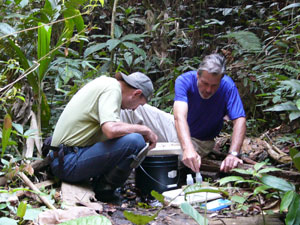
In August 2006, funded by a grant from the Gordon and Betty Moore Foundation, a team of 12 scientists and educators from the Center, along with collaborators from Florida A&M University and from Peru, traveled to Madre de Dios, Peru, for an 18-day expedition to sample 33 sites, which ranged from small streams to the Madre de Dios and Tambopata rivers.
Our research and education staffs worked out of the following five stations: Puerto Maldonado; ACEER Tambopata at Inkaterra (ATI); Los Amigos Research Center and Conservation Area (CICRA); Rainforest Expeditions at Refugio (ARA); and Rainforest Expeditions at Tambopata Research Center (TRC).
In October 2006 scientific and education staff members returned to Madre de Dios to offer a series of free, full-day workshops on water-quality monitoring and the ecology of streams and rivers. The team gave a similar series of workshops at the Fundación Neotrópica on the Osa Peninsula of Costa Rica in December 2006.
Project Goals and Outputs
The Stroud Center’s team had two main goals:
- To establish a baseline of scientific data on water quality, stream biodiversity, and stream health that would serve as the foundation for understanding and sustaining on-going conservation efforts in the region
- To create, test, and implement accessible, easy-to-use, and inexpensive education programs for the people of the region.

The project promised three major outputs:
- The field and laboratory effort sought to test and deploy protocols for measuring and monitoring health in neo-tropical streams
- The scientific findings would provide the basis for creating and offering training workshops for monitoring biophysical properties of streams and rivers in neotropical regions
- Stroud Water Research Center would disseminate training workshop and monitoring research information as broadly as possible.
Specifically, we sought to:
- Assess the current level of water and ecosystem quality across a range of land uses and stream conditions in Madre de Dios watershed.
- Serve as a reference point for measuring the effects of future changes in land use on water quality.
- Develop a standard water-quality monitoring protocol/index that is easy to use, inexpensive, and effective across the region.
- Serve as a baseline for measuring regional effects of broad scale perturbations such as global climate change, aerial transport of environmental contaminants and others.
- Provide a series of environmental education workshops aimed at increasing public understanding of the issues affecting fresh water and giving people the tools to monitor, protect and restore their stream and river ecosystems.
Data
Education Workshops
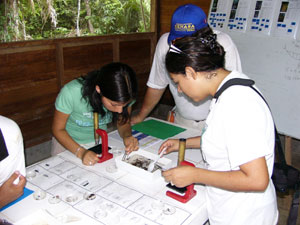
After a number of discussions with people in the region on content, logistics and potential participants, the Stroud Center’s scientific and education staffs decided that the best way to reach the most diverse and significant audiences and to maximize the impact of the work we were doing was to give a series of daylong workshops geared specifically to the following participants:
- Local public- and private-sector decision makers
- Teachers
- Conservation planners, non-governmental organization staff members, and university faculty
- Eco-tourism guides
This focus enabled us to target our educational efforts at groups that could both use the information in their own work and influence a range of audiences that would ensure a broad dissemination of the issues, information, knowledge and monitoring techniques. It also enabled us to engage in discussions with local leaders and workers who are currently in positions to make decisions about the use and protection of water resources and with teachers whose students will become the stewards of the future.
Presented in Spanish and offered free of charge, the workshops bolstered the conservation efforts of core preserved areas in the neo-tropics, discussed the latest scientific and educational knowledge on issues affecting fresh water, offered practical and affordable methods for monitoring streams and rivers, taught stewardship practices that the participants can both use themselves and transmit to others, and encouraged appropriate conservation policies in the region — particularly the importance of maintaining forest cover.
Each workshop began with a discussion on the local and global importance of clean fresh water, the many roles clean water plays in their personal lives and local economies, a basic understanding of the ecology of streams and rivers, and usable ways to determine the health of the water in their communities. The opening lecture set the stage for the rest of the day by framing the issues, providing simple but essential statistical and general information about water resources, explaining the relationship of land use to stream health and the impact of human activities on water quality, and discussing the critical role that streams flowing through conserved areas play in the region.
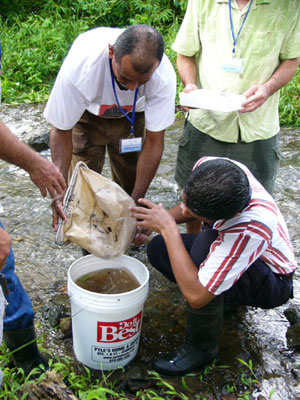
Workshop participants then visited a nearby stream where they perform actual measurements of water quality and to collect aquatic macroinvertebrate animals — insects, snails, crabs, and worms — that provide a biological measure of stream health. The group learned how to make basic measurements of water flow and chemistry and to collect and identify aquatic organisms. An introduction to macroinvertebrate identification and the role the stream animals played as indicators of water quality was presented prior to a laboratory session spent sorting and identifying the animals they had collected that morning.
While North America and Europe have a long history of biomonitoring, including well-defined sampling protocols and analysis methods, protocols for Central and South America are in earlier stages of development. Development of simple macroinvertebrate analysis tools, widely used in the United States, is difficult when the macroinvertebrate community is not well known.
In Peru we focused on the abundance and types of taxa identified as indicators of stream health. A comparison of four streams in the Madre de Dios representing different land uses illustrated how basic chemical and biological monitoring could help determine future conservation restoration or conservation priorities. During the Costa Rica workshops we also tried using the Virginia Save Our Streams metrics with fairly good success. The need for simple macroinvertebrate analysis tools remains a future need.
Perhaps the most consistent message that came through in both verbal and written commentary on the workshops was “we want more” — more information, more time to learn, more and better tools to make a difference, more workshops in the future for people to attend. A corresponding message was “we want it now”… because, with the rate of change in the region, time is of the essence.
Training Resources
The following resources were developed for the water quality workshops organized as part of the Peru Project. We encourage others to utilize the training template and resources provided.
Workshop Recruitment, Organization, and Evaluation
Training Tools
- Water Quality Sampling Basics
- Importance of Water (Peru)
- Importance of Water (Costa Rica)
- Macroinvertebrate Identification
- Introducción a la identificación de macroinvertebrados
- Hoja de clasificación de macroinvertebrados (This document prints best on 11 x 17 inch paper.)
- Guía de identificación de macroinvertebrados
- Macroinvertebrados de Peru
- Madre de Dios – Macroinvertebrates of Rivers and Creeks Along the Interoceanic Highway, Field Guide from the Field Museum in Chicago
- Data interpretation: Basic comparison of four streams in Madre de Dios
Conservation Issues
Conservation Q & A was developed as a series of questions about important conservation issues facing the Madre de Dios region and answers based on insights gained from this study. Conservation Q & A can be in the project final report.
Publications
Ecosystem metabolism and nutrient uptake in Peruvian headwater streams
Mayfly communities in two neotropical lowland forests