The River Continuum Concept
At the end of the Rockefeller study, Stroud Water Research Center invited water researchers from across the country to a two-day conference. It was here that Stroud Water Research Center scientist Robin Vannote, Ph.D., first presented his river continuum hypothesis, which would have a deep impact on aquatic studies.
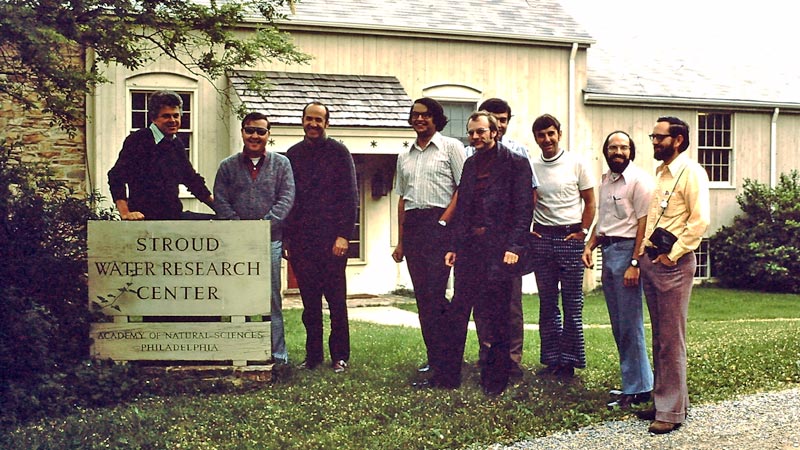
“In those days,” he recalled years later, “most people studied a square meter of water to death.”
But, he told the assembled scientists, it is time to move beyond the notion that you can understand how a river works by studying a tiny piece of it.
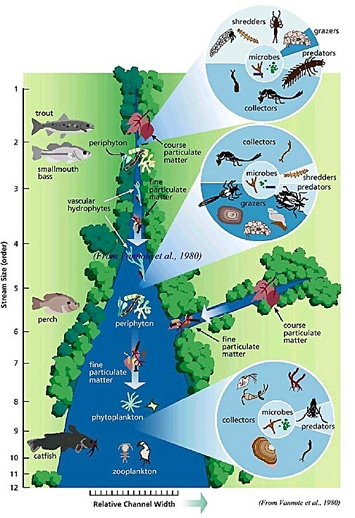
A stream is fundamentally different from a lake, and you must consider how the entire system is functionally linked. Because a river changes constantly as it moves downstream, it can only truly be understood as a continuum.
As a young graduate student named Bern Sweeney remembered it, when Vannote outlined his seemingly simple notion, “the scientists gathered in that room were just in awe. It was a major, major event.”
From those early insights, Vannote, other Stroud Center staff, and a few university colleagues developed the River Continuum Concept, which would revolutionize stream research.
The concept did not materialize out of thin air. Vannote had a voracious intellectual appetite, and his ideas were built on earlier work, both within and outside his field. There was a direct line to the 1948 Conestoga studies, in which Ruth Patrick had broken new ground with her insistence that the diverse biological communities inhabiting a stretch of stream make up a single mosaic. In their Rockefeller work two decades later, Stroud Center scientists established the importance of studying the entire watershed.
During the same period, noted geologist Luna Leopold was developing a formula for understanding a stream’s physical behavior. He saw that a river’s width, depth, velocity, and temperature change constantly as the water flows downstream. More importantly, he recognized that those changes are interrelated — and because a change in one factor affects all the others, a river’s pattern is predictable.
Drawing on these earlier biological, chemical, and physical studies, Vannote and his colleagues added a critical element to the puzzle of how streams work. They argued that a river’s biological and chemical processes correspond to its physical attributes and that the nature of biological communities changes in a downstream direction just as the river itself does. This means that the structure of the biological communities is also predictable and that the communities adapt, as we saw in the last chapter, to the particular conditions of a stretch of stream.
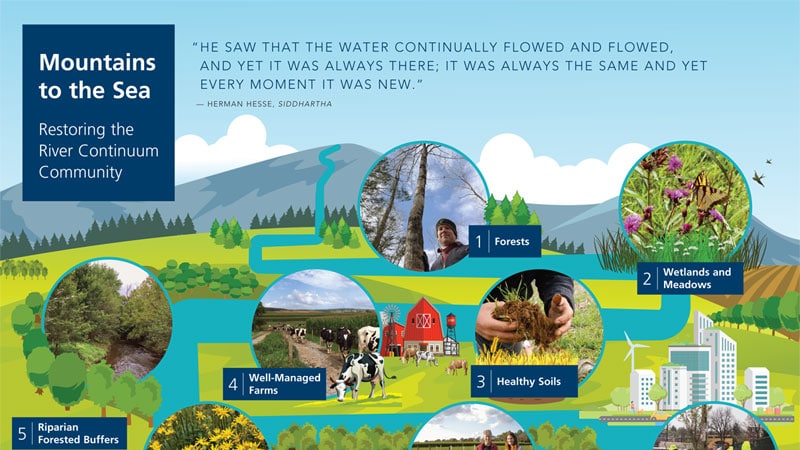
A river is more than the sum of its parts, Vannote asserted. It is not a static body of water. It is a single continuum that flows ceaselessly from its source to the sea. To understand what is happening at any point along the way, you must understand both what is happening upstream and what is entering from the watershed.
The River Continuum Concept was the first unified hypothesis about how streams and their watersheds work. It is considered the most cited article in the history of stream and river ecology, and it established the Stroud Center as a pioneer in innovative research.
Your gift can empower Stroud Water Research Center’s scientists to find ways to ensure clean fresh water around the world for generations to come. Donate today.