Stroud Scientists at Work
Pursuing Science Half a World Away: The Fly River in Papua New Guinea
Stroud Center Hosts International Visitor Leadership Program
By Drs. James G. Blaine and David B. Arscott
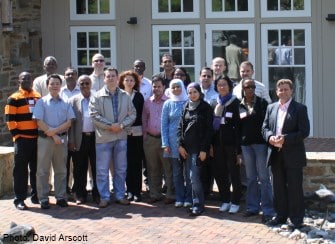
Visitors from 20 different countries recently spent the day at the Stroud™ Water Research Center to learn about the Center’s freshwater research and education programs and tour the facilities and grounds. The International Visitor Leadership Program (IVLP) is the U.S. Department of State’s premier professional exchange program that seeks to build mutual understanding between the U.S. and other nations through carefully designed visits to the U.S. for current and emerging foreign leaders.
The IVLP program started in 1940 and has hosted thousands of distinguished individuals, including more than 290 current and former chiefs of state and heads of government, thousands of cabinet-level ministers, and leaders from both public and private sectors. The countries represented on the visit to Stroud™ Water Research Center were Australia, Bangladesh, Botswana, Burma, Colombia, Jordan, Kazakhstan, Kosovo, Morocco, Namibia, Pakistan, Poland, Romania, Rwanda, Slovak Republic, Somalia, Sudan, Taiwan, Vietnam, and Yemen.
The program goals during this visit were to (1) review U.S. efforts to protect the quantity and quality of surface and ground water supplies at local, state, national, and international scales, (2) to assess trans-boundary water management programs for conserving, developing, and allocating shared water resources, and (3) to examine innovative technologies for monitoring, assessing, and conserving water resources.
FOCUSING ON WATER RESOURCES PROTECTION IN THE U.S.
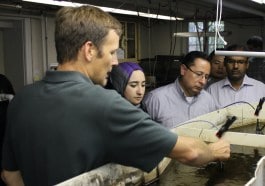
The visitors spent part of the day listening to a series of presentations on the Stroud™ Water Research Center’s research and education programs from Drs. Dave Arscott (assistant director), Willy Eldridge (molecular fish ecologist) Anthony Aufdenkampe (organic geochemist), John Jackson (aquatic entomologist), and Susan Gill (director of education). The topics ranged over a diverse cross-section of ongoing and recent projects including the Stroud Center’s project on water quality in the New York City drinking water supply watersheds; fish responses to thermal pollution; the role of rivers in the global carbon cycle; using aquatic macroinvertebrates for water quality monitoring; and the Center’s environmental education programs.
“…the group said Stroud was the definite highlight [of the 3-week tour]. It was the only place they could get their most difficult questions answered.” Joanne M. Clark, Meridian International Center
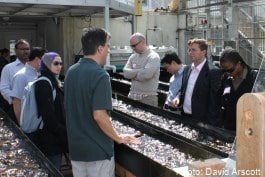
The visitors had plenty of opportunity to explore the facilities and were treated to hands-on viewing of many ongoing experiments, complemented by interactive discussions with the Stroud™ Water Research Center’s scientists and educators. The group ended the day with a watershed walking tour to explore the streamside forests, outdoor experimental flumes, and watershed monitoring installations. The weather was perfect, and the group and Center’s staff all had an enjoyable and productive day.
“We are really thankful to Stroud for spending a full day with us and for educating us on their excellent work.” Mr. Panhwar, Pakistan
Stroud Educators at Work
Expanding the Leaf Pack Network® to South and Central America
Outreach
Welcome to the Future: A Talk by Peter Gleick
By Dr. James G. Blaine
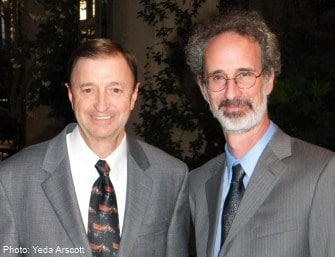
Peter Gleick is an optimist who labors in a field that is increasingly populated by pessimists. The field is fresh water—and at the Stroud™ Water Research Center’s 8th annual The Water’s Edge, Dr. Gleick spoke knowledgeably and passionately about “Water in the 21st Century: New Thinking for a Sustainable Future.”
He opened by noting that there is “a lot of bad news about water.”
He closed by saying, “I can imagine a world where the human right to water is met.”
In between, Gleick, founder and president of the Pacific Institute in Oakland, Ca., took the audience of 220 in the Longwood Gardens ballroom through a historical and geographical tour of water issues, peppering the journey with allusions ranging from Dante to Yogi Berra.
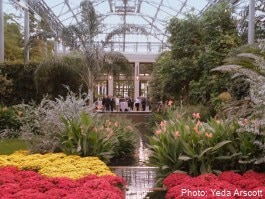
As we enter the “Third Age of Water,” said Gleick, we need to recast our old ideas about our most critical resource. During the 1st Age, which lasted from the dawn of human history into the 19th century, people took water where they found it and when they wanted it, and they dumped their refuse back into the water, which carried it away. In a world of few people living short lives in sparse settlements, this system worked fine.
Although imperial Rome is famed for its aqueducts, the 2nd Age of Water really began in the 19th century when the Industrial Revolution and urban growth made it possible—and imperative—to store, transport, and filter huge volumes of water. In a period characterized by vast engineering projects and unprecedented advances in science, humans learned to provide clean water to millions of people, to grow increasing amounts of food on decreasing areas of land, and to eradicate such water-borne diseases as typhus, dysentery and cholera in many parts of the world. But great progress brought immense problems, and now, 150 years later, the world faces a water crisis.
WHAT IS THE CAUSE OF THE GLOBAL WATER CRISIS?
The simple answer is: we are. The world’s population now approaches 7 billion and is expected to increase by another 3-4 billion before leveling off in 2050. The amount of the world’s water, on the other hand, has not changed since the world began, which means that each person’s share has declined substantially. But per capita demand continues to grow rapidly, powered by economic expansion, the dependence of agriculture and industry on massive volumes of freshwater, and the universal desire for a better life. Clearly we are on a collision course with the future.
Humans have postponed the day of reckoning in three ways: (1) Engineering: We have diverted rivers, constructed massive dams, and built reservoirs capable of storing trillions of gallons of water. In the process, we have irrevocably changed entire ecosystems to the point that rivers, from the Colorado to the Yellow, no longer flow regularly to the sea. (2) Overuse: We are pumping our groundwater at an unsustainable rate. Almost half the world’s food production now depends on irrigation from non-renewable aquifers, while the effort to make the central Asian desert bloom caused the destruction of the Aral Sea and the extinction of all 24 species of its endemic fish. (3) Misery: The way we use water has led to a world tragically divided between haves and have-nots. Two million people continue to die each year from completely preventable water-borne diseases. Almost all of them are in the Third World, and most of them are under 5 years old.

The competition for limited resources has increased the probability of conflicts over water and the risk of violence. Such threats must now be seen in the context of two larger issues: the reality that humans are part of the ecosystem they abuse and the irreversible fact of climate change, which “is having a serious impact on our water resources.”
And yet, the story need not end there, said Gleick. “A lot of good things are happening. We are making progress, but we must make it faster.”
To do so, Gleick laid out what he calls the “soft path” to sustainable water use. Its underlying principles are that water is “a fundamental human right,” that there is also a “basic ecosystem right to water”—and that the two rights are not in conflict. In fact, ensuring the human right to water requires us to protect the ecosystem from which that water comes.
DEVELOPMENT THAT ENCOMPASSES ENVIRONMENTAL PROTECTION
“Throughout the 20th century, the industrial world pursued economic development without concern for environmental protection,” Gleick said in an interview. “That is still happening, as emerging nations seek to attain the West’s standard of living. But we are moving toward development that encompasses environmental protection. I do not believe there is an inherent contradiction between the two. I do not believe we are doomed.”
Specifically, he argued, we must meet the ever-growing demand for goods and services with less water. The good news is that we have already begun to do so: the U.S. actually uses less water today than 30 years ago; the city of Los Angeles consumed more water in 1969 than it did in 2009. We must also “think outside the box about supply” by recognizing treated waste water as a source of supply, not just scrubbed waste to be thrown away.
Gleick ticked off a list of things to do: Ensure the basic water needs of all are met. Protect water quality by bringing the Safe Drinking and Clean Water Acts into the 21st century. Get rid of a pricing system that rewards wasteful use by discounting for volume. Improve—don’t discard—our regulatory agencies.
Finally, he said, “we must slow the rate of climate change and we must adapt to the unavoidable changes that are coming because we failed to act sooner.”
“Can we reach this rosy future,” he asked in closing “or are we condemned to a perpetual water crisis? The answer depends on the choices we make.
“Welcome to the future.”
Peter Gleick is the eighth distinguished Water’s Edge speaker. The others have been Jane Goodall, Sylvia Earle, William McDonough, Wangari Maathai, Kristine Tompkins, Flip Nicklin, and Ian Hutton.
In the News
Science, Ecology, and Fitness Combine
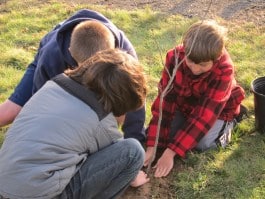
Director Dr. Bern Sweeney was on hand to explain the benefits of streamside buffers to students at Pocopson Elementary School as they planted 200 trees on school grounds. Their aim: to reforest part of their campus and to provide a buffer for the nearby Brandywine Creek. Read the article
Tour of Stroud Center Focuses on Forested Buffers
Director Dr. Bern Sweeney hosted visitors from the Pennsylvania Department of Conservation and Natural Resources and the Chesapeake Bay Foundation as they toured the Stroud™ Water Research Center and learned about its 20 years of research on riparian buffers. Pennsylvania has a goal of planting an additional 19,000 acres of buffers by the end of 2011, which would require an installation rate eight times greater than that of the last decade. Lancaster Farming covered the story.
Chester County’s Share: $4 Million for Environmental Projects
Stroud™ Water Research Center received federal stimulus money to study water quality issues. Assistant Director Dr. David Arscott and Dr. John Jackson discussed the phosphorus study and the project studying how fluctuating water temperatures affect fish and aquatic insects. The Daily Local News covered the story.
Stroud Scientists and Educators Present
Our ability to disseminate our findings to a broad audience allows us to increase awareness and create a public dialogue centered on the protection, preservation and restoration of watersheds everywhere. It’s for that reason that our scientists and educators engage in both scientific and public forums to share their findings. The following highlights recent presentations.
WATER TEMPERATURE FLUCTUATIONS EFFECTS ON FISH
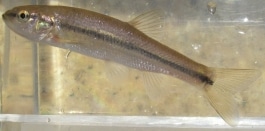
Stroud™ Water Research Center had a presence this year at the annual conferences of the Ecological Society of America and the American Fisheries Society both held in Pittsburgh, Pa. At both of these conferences Stroud Scientist Dr. William Eldridge presented his findings about the effects of daily temperature fluctuations on the growth, survival, and blood chemistry of several warm water fish species. The study focused on the responses of seven fish species: golden shiners, walleye, white sucker, smallmouth bass, bluntnose minnow, spotfin shiner, and channel catfish. The study was conducted in collaboration with the Stroud Center’s director, Dr. Bern Sweeney, and Dr. Mac Law from the College of Veterinary Medicine at the University of North Carolina.
FACTORS AFFECTING STREAM QUALITY AND LONG-TERM CHANGES IN STREAM CONDITION
In November, Senior Research Scientist Dr. John K. Jackson visited the Friends of the Wissahickon to present a seminar titled Water Quality in the Wissahickon. The lecture explored the factors affecting stream quality, long-term changes in stream conditions, and challenges to maintaining and improving stream conditions. Dr. Jackson and his entomology team at the Stroud Center have been studying water quality and aquatic insect life in the Schuylkill River since 1996 with support from the William Penn Foundation, the Delaware Riverkeeper Network, and the Clean Water Fund.
RESTORING THE BRANDYWINE WATERSHED: WHY FORESTED RIPARIAN BUFFERS?
Stroud™ Water Research Center’s Assistant Director Dr. Dave Arscott spoke recently at a landowner workshop hosted by The Brandywine Conservancy’s Environmental Management Center. The workshop at the Brandywine River Museum focused on efforts to reforest streambanks throughout the upper Brandywine watershed.
The Conservancy has recently launched an ambitious reforestation campaign that focuses on improving water quality and stream and river habitat on Conservancy-owned land and on private lands that are enrolled in their conservation easement programs. The reforestation program is voluntary for landowners.
The Conservancy’s program is bolstered by research conducted over the last 40 years at Stroud™ Water Research Center on the relationships between riparian forests and stream ecosystems. Dr. Arscott shared some of this research and discussed the critical importance of forest systems to watershed health and what landowners can do to help restore water quality. The evening also included information about the historical condition of the watershed, recent land use changes, and details of the Conservancy’s reforestation initiative.
EDUCATION DEPARTMENT PRESENTS LEAF PACK WORKSHOP IN COSTA RICA
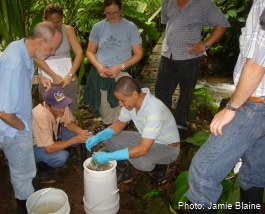
On November 17, Stroud™ Water Research Center Educators Christina Medved and Jamie Blaine traveled to Baru, Costa Rica to present a Leaf Pack workshop for local communities to learn about ways to monitor and protect their natural resources. The workshop was sponsored by the Asociación de Amigos de la Naturaleza del Pacífico Central y Sur (ASANA) and hosted at Pitzer College’s Firestone Center for Restoration Biology in Baru.
The workshop was offered in response to a proposal ASANA had made to the Asociación Centro de Investigación Stroud (ACIS) “for the use of the Leaf Pack technology to monitor the health of the rivers and streams of the Path of the Tapir Biological Corridor, educate the local residents as to the importance of their watersheds to the health and well-being of the communities, and improve the protection of the watersheds in the corridor.” The corridor is made up of about 20 nature reserves, half of which currently have some form of official recognition, and about 20 rivers flow wholly within the corridor’s boundaries.
Like what you’ve read? Subscribe!