Stroud Scientists at Work
A Critical Zone Observatory for the Christina River Basin
With funding from the National Science Foundation (NSF), scientists from the Stroud™ Water Research Center and the University of Delaware will establish a Critical Zone Observatory (CZO) in the 895-square-mile Christina River Basin that spans southeastern Pennsylvania and northern Delaware.
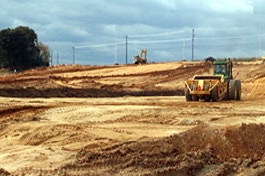
The critical zone is that area which extends from the top of the tree canopy to the bedrock at the base of the soil column, where life as we know it takes place. The new Christina River Basin CZO is one of six observatories in the U.S., and the only one in a landscape inhabited for centuries by humans. The research aims to settle a scientific debate on whether human-induced erosion modifies greenhouse gas emissions from the landscape.
NSF has established six CZOs, ranging from alpine regions in the Rocky Mountains to the wet tropical forests of Puerto Rico, each of which represents a different geographic region with specific land forms, bedrock types, and climate. This network of observatories provides a national resource for scientists studying the fundamental geological, biological, and chemical processes that regulate life on Earth.
Stroud Center scientists and their University of Delaware (UD) colleagues suggest that erosion by agriculture and urbanization constitute a major geological process, and the grant provides them an opportunity to study the impacts of those activities on carbon exchanges among land, water and the atmosphere — processes that are critical components of climate change models.
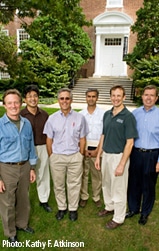
Stroud Center scientist Anthony Aufdenkampe will coordinate the research that will trace the fates of carbon, water and sediments as they travel from uplands to the Delaware Bay. “Our overall goal will be to understand and quantify what happens to the carbon cycle when human earth-moving activities mix plant carbon and rock minerals, two components that are typically separated within soils,” said Aufdenkampe. “By bringing together scientists from multiple disciplines, we’ll be better poised to answer questions about these complex processes,” adds Kyungsoo Yoo, assistant professor at UD, whose research centers on weathering and soil carbon cycles.
The Christina River Basin, which includes the White Clay, Red Clay and Brandywine creeks, is an ideal natural laboratory for this research. “The project provides an exciting opportunity for teams of scientists to look back at centuries of settlement, forest clearing and agriculture, as well as the more recent processes of urban and suburban growth, to understand the historical impacts of human activities on the carbon cycle,” said Lou Kaplan, senior research scientist at the Stroud Center and one of the principal investigators on the study. “Our studies will span broad scales, ranging from the chemistry of individual molecules to the vastness of the entire Christina River Basin.”
STATE-OF-THE-ART TECHNOLOGY WILL BENEFIT A BROADER COMMUNITY
At the heart of this study will be new, state-of-the-art technology and a cyberinfrastructure that will enable scientists to automate data collection now done manually; the automation will massively increase the extent and frequency of collection. Scientists will move from bi-weekly collection followed by lab analysis to accessing real-time data every 15 minutes or more — while their colleagues thousands of miles away will have access to it in a searchable database via the internet. Said Aufdenkampe of the technology, “The increased frequency and accessibility of the data promises to catalyze new insights and collaboration, while providing a more accurate picture of the processes being studied.”
Additionally, the CZO will expand the number of collection sites to many more groundwater sites and streams and will increase the data types studied to include new chemistry of sediments and more. All of this research data will be collected from forested, agricultural and suburban landscapes in the watershed to help the research team better understand the relationship between specific landscape disturbances and carbon sequestration, and that information, in turn, will inform education programs that are anticipated in the fourth and fifth years of the study.
Trees Improve the Health of Our Waterways
Op-ed piece, as seen in The News Journal and delawareonline.com
When Henry Hudson sailed into Delaware Bay in 1609, he found all around him an unbroken band of old-growth trees. As he sailed up the river toward what is now Wilmington and Philadelphia, he saw waters teeming with fish, woods filled with wildlife, and native peoples drinking water straight from the streams. So thick were the forests that a squirrel could have traveled from Dover to Wilmington without setting its feet on the ground. The European settlers who came soon after Hudson, however, saw the trees as both an impediment to progress and a resource to exploit. Within 200 years Pennsylvania — “Penn’s Woods” — had become one of the great misnomers in history, as the settlers cleared millions of acres for farmland, timber and fuel. That progress had a price, and we are still paying it.
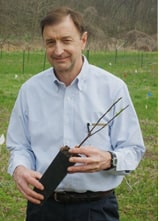
For scientific studies now confirm that those trees were the foundation of the exceptional quality of the water in the region’s streams and rivers and the enormous fertility of the Delaware estuary. Here’s why. Almost every drop of rain that fell penetrated into the soil, which was soft and rich in organic matter because over a ton of leaves fell annually on each acre of ground. The water worked its way slowly downhill, irrigating the forest and eventually adding itself to the stream.
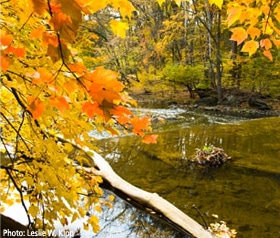
At the stream’s banks, the forest slowed the entry of nutrients into the water and protected the floodplain from erosion. Its soils were so absorbent that even in periods of flooding most streams ran clear. The trees also provided the shade necessary to support cold-water plants and the fish, primarily trout, that feed on them. Scientists have known for a long time about the value of riparian forests as buffers that keep pollutants out of a stream. We have more recently discovered that trees do much more than that. By supplying the leaves, fruits and seeds that feed the great diversity of aquatic life, they actually enable streams to clean their own waters. A healthy stream ecosystem can provide critical services — from filtering the water to mitigating flooding — for which humans now depend on water-filtration systems, sewage-treatment plants and massive dams. We now pay billions of dollars for those services. A healthy stream can provide them free of charge.
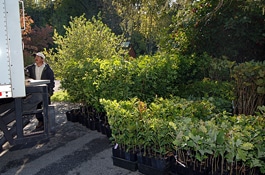
We will never again have in this region the unbroken expanse of forest that greeted Henry Hudson 400 years ago. And we will probably never again be able to drink water directly from our streams. But there is no reason that our streams and rivers can’t once more teem with life, be safe places for recreation, and provide a source of drinking water that does not require elaborate and expensive treatment. During the past decade, the Stroud Center has studied hundreds of streams from Quebec to Florida, and we have found that the single most important factor in determining the quality of a stream’s water is the amount of forested land in its watershed. The best streams usually have a high percentage of forest; the poorest typically do not. Simply put, replanting trees along a treeless stream, on the hills of a treeless watershed, or in the backyard of a treeless home improves the quality of the water.
And doing so is not expensive. In fact, there are a number of programs to help farmers and other landowners plant trees on their properties that are convenient and easy to access — the Natural Resource Conservation Service, State Farm Bureau, County Conservation District and local watershed associations are all places where people know about funding opportunities.
Clearly, though, it isn’t just money that keeps landowners from planting trees. We have a long history to overcome — from our reliance on massive engineering projects to solve water issues to decades of marketing campaigns that extol the beauty of weedless lawns and treeless landscapes. If we are to make streamside forests truly best practices in the region, we must recognize the limits of engineering solutions and include in our economic calculations the value of the services nature can provide. It is hard to imagine that the landscape Henry Hudson discovered was less beautiful than today’s. It was certainly healthier and its water far cleaner. Trees were the reason for that, scientists now know, and they can be again. In fact, the simple act of planting a single tree can be the first step in the restoration of both our land and our water.
Bernard W. Sweeney, Director
James G. Blaine, Educator
Stroud Water Research Center
Stroud Educators at Work
Model My Watershed®: An Innovative Approach to Teaching Environmental Science
Engaging students from a young age in math, technology, and the environmental sciences is a challenge that many teachers face, one that has a special urgency because American students have fallen behind their peers in many other countries. But with competition for a child’s attention now so fierce, how does a teacher make these subjects fun, interesting and relevant? What will it take to capture the imagination of young people and cause them to consider a career path in one of these fields? These are the fundamental questions that Stroud Center educators addressed when they began to envision Model My Watershed®, an innovative web-based educational platform, recently funded by the National Science Foundation (NSF).
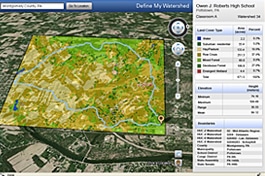
Building on Google Earth technology, Model My Watershed® will enable students to learn about the watershed in which they live and the impact that land-use and other changes have on their environment and the water quality of their streams.
The project, which received a three-year grant from NSF’s Innovative Technology Experiences for Students and Teachers (ITEST) fund, aims to excite students about science and math and to help rebuild the U.S. talent pool through programs that cultivate skills that American companies have increasingly had to fill with workers from abroad.
GETTING STUDENTS HOOKED ON SCIENCE
“The key to the success of this program will be to create a tool that doesn’t disenfranchise students,” said Dr. Nanette Marcum-Dietrich, an assistant professor at Millersville University. Marcum-Dietrich will be involved in the collaborative effort to design a curriculum, which will seek to convey to students that science is more than just facts in a book, that it is not too complex for them to understand, and that there are still exciting discoveries waiting to be made.
Her goal is to bring science education to her students in ways that make it tangible for them. “If we don’t,” she said, “we’ve really robbed them of their voice.” Model My Watershed® seeks to do that by creating a tool that allows the students to use what they already know, incorporates their strengths and interests, and engages them.
Among the things they care most about, Marcum-Dietrich said, are water and the environment around them. “What these kids know best,” she said, “is their own backyard”, adding that she has seen firsthand that they will put their effort into things that matter to them and that affect their own community.
EXPLORING THE SCHUYLKILL WATERSHED FROM THE DESKTOP
While the goal of the program is to deliver an authentic learning experience to all 200,000 Philadelphia-area students, and ultimately to roll it out nationally and even globally, math and science teachers from seven area schools will pilot the tool set and related curriculum on their 7th-12th graders.
Among the first participants will be an enthusiastic science teacher at an urban school in west Philadelphia. Theresa Lewis-King, who teaches 11- to 15-year-olds at the Rudolph Blankenburg School, is thrilled at the prospect of making science come alive for her students. “I believe in hands-on, authentic learning experiences,” she said. “We’ve got to make it real for them, make it accessible, and empower them with the ability to discover how it impacts them and their community.” The trick, in her opinion, is to harness all the energy they possess by delivering a curriculum they can embrace. “If it is disconnected from their everyday life, it goes in one ear and out the other.” Make it personal, and you’ll get their attention.
In Lewis-King’s view, the new curriculum will help her students demystify science by making the conceptual real to them. The interaction with scientists through “In Time Learning” modules, including QuickTime movies, will demonstrate that entertaining and interesting people actually do science for a living. “And when the kids are hooked,” she said, “I can visualize them saying, ’Wow! Ms. Lewis-King, I could do this! I could actually do this!’” With a smile she affirms that this will indeed be fun, and this will make a difference to her students and to her community. What could be better?
USING WEB 2.0 TOOLS TO ENGAGE STUDENTS
Model My Watershed® will introduce the so-called STEM disciplines (science, technology engineering and math) with tools that are both familiar and fun to middle- and high-school students. Google Earth will serve as the foundation of the platform, over which scientific data, a hydrologic tool kit and geographic information systems (GIS) will be overlaid, so that students can easily locate their own watershed online. They can then use Google Sketch Up to alter the environment, immediately seeing the impact of their proposed changes. The overall experience will be designed to leverage the feel of popular video games and the data sharing of social networking applications.
“Model My Watershed® will allow students to experience firsthand the nature of science by exploring their neighborhoods and learning about their watersheds,” said Susan Gill, director of education at the Stroud Center. Putting the students in charge “virtually” of the factors that affect their own watershed is a powerful motivator for engagement and a powerful impetus to have students become environmental stewards and hopefully consider a STEM career.
Learn more about the Stroud Center’s education programs.
Outreach
The Event of the Season: A Sustainable Feast
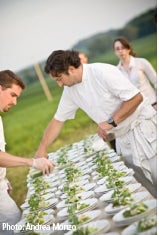
June 19th was a memorable evening where community and friends, both old and new, gathered before a setting sun and stayed to dine under moonlight en plein air. On a hilltop overlooking the rolling fields of Chester County that produced much of the evening’s bounty, guests of all ages were treated to a sumptuous meal prepared by renowned chef Bryan Sikora of Talula’s Table in Kennett Square, Pennsylvania.
The event, which was designed to highlight the watershed education programs of the Stroud Center, celebrated local, sustainable agriculture and highlighted the farmers’ dependence on clean, fresh water and a healthy watershed to produce our food. It provided a wonderful opportunity to recognize the hard work of our local producers, to acknowledge their efforts towards sustainability, and to underscore the necessity of protecting the water supply that both nourishes our foodshed and is essential to all life.
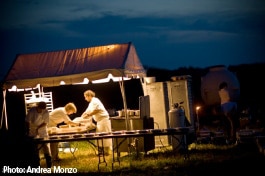
More than 120 people wandered in casual procession up a freshly mowed path to a long, elegantly draped table adorned with local wildflowers and mushrooms, which set the tone for an unforgettable repast. The first sunshine in days was reason enough to celebrate with a glass held high. And toast the evening we did, first with a cool glass of Victory Whirlwind Whitbier, courtesy of Downingtown-based Victory Brewing Company, followed by Victory Hop Devil and a wonderful dessert beer, Victory Baltic Thunder. For the wine lovers, Anthony Vietri’s family-owned vineyard, Va La of Avondale, Pennsylvania, generously provided a selection of wines to complement the four-course meal. Va La winery’s Prima Donna, Silk, and Mahogany wines filled stemware into the evening, until the last of the guests followed the soft glow of luminarias to their cars.

Early into the evening, Bill Covaleski, President and Brewmaster of Victory Brewing Company, raised his own glass. “We rely on the East Branch of the Brandywine for high quality water for our beer making,” he said. “The mineral composition and makeup of water significantly impacts the beer it goes into…so, I raise a glass to great local water, and the efforts of the Stroud Center and all those who endeavor to understand and protect our vital watersheds.”
“I have seen food bring out the best in people; never have I seen it bring out so much magic though,” said Aimee Olexy of Talula’s Table. “The Sustainable Feast was an evening of eating, drinking, opinions, agriculture, friends, and moonlight. The event matched the cause perfectly. It was an experience I think we are all still digesting.”
AN ELEGANT REPAST
Passed hors d’oeuvres, including Eastern Shore crab canapés, Birch Run beef croquettes and Inverbrook Farm chicken liver toasts with rhubarb, were just enough to tease the palette while guests mingled and took in the spectacular view. Freshly made breads and a summer vegetable salad graced the table, followed by a creamy polenta with chicken, fresh peas and wild green garlic sauce. Dr. Elkins beef appeared with root vegetables and organic Kennett mushrooms in a whimsical potpie topped with a pastry crust cow. And dessert lovers will long remember the strawberry crepes with local sheep’s milk yogurt and peppermint, like summer on a plate.
OUR GENEROUS SPONSORS
This spectacular evening, the proceeds of which benefited the Stroud Center, was made possible by the following sponsors: Applestone Farm, Inc., Ardenheim Clay Works, Birch Run Beef, Buck Run Farm, Dawson’s Seafood, Glen Willow Orchards, Highland Farm, Hugh Lofting Timber Framing, Inc., Inverbrook Farm, Andrea Monzo Photography, Meadowset Farm & Apiary, Natural by Nature, P in the Pod, Inc., Phillips Mushroom Farms, Rushton Farm Willistown Conservation Trust, Scarlett Thicket Farm, Bob and Trish Scott, SIW Vegetables, Morris and Boo Stroud, Talula’s Table, Va La Winery and Victory Brewing Company.
In the News
WHYY Radio Highlights an Ambitious Project to Barcode the World’s Freshwater Species
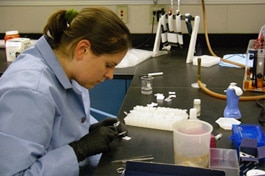
The International Barcode of Life (iBOL) project, which hopes to assemble a DNA sequence library of the world’s species using barcode technology, has appointed Dr. Bernard W. Sweeney, Director of the Stroud Center, to colead its Freshwater Surveillance group. One of iBOL’s ten working groups, each of which is focused on different organisms and environments, the Freshwater Surveillance group is particularly important as freshwater ecosystems are the most threatened by human activity, freshwater species are of particular socio-economic import, and they are also the standard metric used by scientists in environmental assessments such as water quality monitoring. WHYY health and science reporter, Kerry Grens asked Dr. Sweeney to explain the project’s mission and why it matters. The interview, which hit radio airwaves on July 13th and still resides online, features both Sweeney and iBOL’s Scientific Director and Integrative Biology Professor at the University of Guelph, Paul Hebert. Said Sweeney of the project, “Our initial focus will be on macroinvertebrates and fish, mainly because macroinvertebrates and fish are widely used for evaluating water quality throughout streams, rivers, and lakes throughout the world.”
New Critical Zone Observatory Seeks to Answer Climate Change Questions
With data from a new Critical Zone Observatory in the Christina River Basin, scientists are hoping to answer questions about how erosion caused by humans is affecting the carbon cycle and may affect climate change. The $4.3 million grant awarded by the National Science Foundation (NSF) to the University of Delaware and Stroud Water Research Center makes this one of six Critical Zone Observatories in United States. Rachel Kipp of The News Journal covered the story.
Considering the Role of Inland Waters in the Carbon Cycle and Climate Change Mitigation Strategies
In a paper published in the September issue of Nature Geoscience, scientists from Uppsala University in Sweden, the University of Vienna, University of Antwerp, and the Stroud Center argued that lakes, rivers, streams and wetlands (inland waters) play a significant role in the sequestration, transport and mineralization of organic carbon. Their hope is that the role of fresh waters will be considered by the 192 global leaders who will gather at the December 2009 UN Climate Change Conference in Copenhagen (COP15) to develop global strategies to mitigate manmade carbon emissions and address climate change. Allan Loudell of WDEL news talk radio interviewed Anthony Aufdenkampe for the story.
Stroud Scientists and Educators Present
Disseminating Our Findings to our Peers and the Public at Large
Our ability to disseminate our findings to a broad audience allows us to increase awareness and create a public dialogue centered on the protection, preservation and restoration of watersheds everywhere. It’s for that reason that our scientists and educators engage in both scientific and public forums to share their findings. The following highlights recent presentations.
OUR PARTNERS IN STEWARDSHIP: WATERSHED ASSOCIATIONS
Stroud Center educator Vivian Williams spoke to the Chester-Ridley-Crum (CRC) Watersheds Association on September 12th as part of the association’s annual efforts to train new volunteers and review quality control protocols to ensure that the water quality data collected by this mostly volunteer group of waterkeepers is of consistent quality.
The group’s efforts focus on the Chester, Ridley and Crum streams — major sources of drinking water for the area, including the town of Media, PA — and help to document water quality. The primary reason for the good quality of much of Ridley Creek is the riparian corridor provided by the trees in the Ridley Creek Park and Tyler Arboretum.
Vivian was honored for her contributions in the field of watershed education by the Chester-Ridley-Crum (CRC) Watersheds Association at their Annual Awards Dinner, which was held at the White Manor Country Club in Malvern, PA on Nov. 4th.
THE VALUE OF STREAMSIDE BUFFERS
Municipal officials and members of the public gathered at PPL Wallenpaupack Environmental Learning Center to hear educator Vivian Williams present the findings from buffer research conducted over decades by the Stroud Center — reinforcing what was so eloquently stated in the opinion piece, Trees Improve the Health of our Waterways, by Jamie Blaine and Bernard Sweeney in The News Journal during the month of October.
In his commitment to educate the community at large, conservation organizations and our public officials about the science behind the benefits of streamside forests, best practices for planting and maintaining them, how to overcome objections and seek funding for these efforts, the Stroud Center’s director Bernard Sweeney also addressed attendees at events hosted by the Chesapeake Bay Foundation, Pennsylvania Department of Conservation and Natural Resources, and the Natural Resource Conservation Service. In addition, senior scientist John Jackson presented, Trees, Streams and Water Quality: The Connections, to the Perkiomen Watershed Conservancy and Lower Salford Township in September.
JUST WHO OWNS THE WATER, ANYWAY?
As Communication Studies students at West Chester University (WCU) learned in a lecture given in a conflict resolution course, Who Owns the Water is a complicated and challenging issue. Exactly how complicated, was an eye opener for many students who sat wide-eyed at the facts they learned from Stroud Center educator Christina Medved about where their water comes from, just how much it costs, and why people around the world — and here in the U.S.A. — are fighting over it. The key take aways? Resolving our freshwater crises will take understanding, cooperation, and vigilance by each of us. It’s in our best interest to become educated about the issues, to engage in finding solutions, and to do our part on a daily basis.
“Not only did the students report that this topic was interesting,” said Dr. Denise Polk, Assistant Professor of the Department of Communication Studies at WCU, “but a purpose of the guest lecture series was to give students ideas for developing their own projects to advance an environmental issue. As a result of Christina’s presentation, one group selected water conservation at West Chester University; they have designed a survey posted on Facebook and are collecting data about WCU student water usage as one part of their project.” Perhaps most satisfying of all, Polk went on to say that “undoubtedly the students will walk away with a much more sophisticated understanding of the complexity of issues surrounding limited resources such as water, as well as a sense of empowerment that they can do something about these issues.”
TAKING WATER FOR GRANTED
Members of Delaware’s Hockessin-Greenville Rotary were reminded of the vital need to protect and conserve our freshwater resources at a September breakfast presentation entitled, Backyard Solutions to a Global Water Crisis, by Bernard Sweeney, director of the Stroud Center. Sweeney outlined scenarios that most of us rarely think about but which put our limited water supply at risk. He reminded guests that our underlying health, as well as the economy, rely on the availability of fresh water. “We really take it for granted,” said one attendee after the presentation. “There’s an assumption,” said Sweeney, “that we have a right to fresh water — and that it will always be here, yet we see that this isn’t the case in many places around the world.” As Sweeney pointed out, it’s our collective responsibility to ensure that we do what we can to protect and conserve our water supplies in our own communities, and the good news is that there are many things we can do as individuals. Step one: conserve.
STREAM METABOLISM & DISSOLVED ORGANIC MOLECULES
The Gordon Research Conference on Catchment Science: Interactions of Hydrology, Biology, and Geochemistry, was the setting for senior research scientist Lou Kaplan of the Stroud Center to present research on dissolved organic matter and its role in stream metabolism. In his poster presentation, Whole-stream measurement of semi-labile dissolved organic matter uptake, Kaplan described an innovative combination of novel methodologies used to determine the amount of organic molecules being used for energy by microorganisms in a stream ecosystem. These methods include the use of bioreactors he developed and patented in the 1990’s and extracts of tulip poplar trees grown in a chamber enriched with 13C (the stable isotope of carbon) carbon dioxide. Kaplan’s data suggest that much of the metabolism in streams is fueled by organic molecules dissolved in the “watershed tea” found within stream water.
The Gordon Research Conferences were established to provide a forum for direct communication between scientists, to promote discussions and the free exchange of cutting edge ideas at the research frontiers of the biological, chemical and physical sciences.
THE MAKING OF GREAT SCIENTISTS
Critical thinking and the ability to clearly articulate hypotheses and findings are seminal facets of a scientist’s training. Poster presentations allow scientists to hone these skills while soliciting feedback from peers. This process ensures the important collaboration and dialogue that are fundamental to the scientific process and move scientific fields forward. As such, Stroud Center scientists encourage the post-doctoral researchers and Ph.D. students they mentor to leverage this important vehicle and present their research at scientific meetings. Most recently, Dr. Yin-Phan Tsang, a research associate at the Stroud Center, and Ms. Christine McLauglin, a Ph.D. candidate at the University of Pennsylvania doing her research at the Stroud Center, presented posters at the Gordon Conference on Catchment Science. Yin-Phan presented her model of stream flow in the White Clay Creek, which incorporated the amount of groundwater evapotransporation (outgassing of water to the atmosphere) by trees in the riparian zone and its impact on the water budget for the stream.
Chris presented her research ideas for integrating the biogeochemical cycling of carbon and nitrogen with the hydrologic cycle to better understand the processes influencing water quality in stream ecosystems. Both Yin-Phan and Chris received scholarships from the Gordon Research Conference that allowed them to accompany Lou Kaplan to this meeting held at the Proctor Academy in Andover, New Hampshire.