Message from the Director
Watershed Neighborhoods
Watershed stewardship is a hot topic these days. But what is it, and how does one learn to do it? Technically, a watershed is a region drained by a stream or river. A steward is a person who cares for another’s property. So, watershed stewardship is taking care of the land that provides flow to our streams and rivers. To me, this boils down to being a good neighbor in an environmental sense because the watershed is really the neighborhood in which we live.
The art of being a good social neighbor has evolved over thousands of generations. Its essence depends less on obeying government regulations than on mutual respect, common sense, and a good attitude. A great neighborhood springs from the desire of a group of individuals to live and work in harmony.
The consciousness of being a good “environmental neighbor” has arisen more recently as the world has awakened to the need to preserve its environmental neighborhoods. Because we have waited so long, the teachers are different, and the teaching is more intense. While earlier generations were rarely trained, either formally or informally, in environmental matters, we now have education programs in universities, public schools, parks, and even on television. These programs are based on hard science — the kind produced by scientists at the Stroud Water Research Center. The lesson plans are then developed by education specialists — such as those at Stroud Water Research Center — who translate big chunks of technical science into meaningful tidbits of information that can be absorbed by laypeople of all ages.
Stroud Center scientists and educators strive to provide the best possible science and environmental education materials because we believe that through them, we can nurture the most effective watershed stewards and build the best environmental neighborhoods.
Bern Sweeney
Director
News
Smooth Sampling in New York
As fall casts its colors across the Catskills, Stroud Center field crews are wrapping up their second season of sampling the streams and reservoirs that provide New York City with its enviable water supply.
Charles Dow, the Stroud Center’s New York Project coordinator, was happy with the progress made in this year’s sampling operation.
“It went much more smoothly than last year,” said Dr. Dow.
Unless the watershed is hit by a late-season hurricane or some other disaster, the sampling is expected to be completed a month earlier than in 2000, when heavy storms, bureaucratic delays, and other problems slowed things down.
Sampling the streams and reservoirs across the 2,000 square miles of watersheds that supply the city’s water is a massive undertaking. The project, which is being conducted with state and federal funding under contract to New York State, involves all research and administrative sections of the Stroud Center.
The Stroud Center was selected to do the project because increasing development in the watersheds is threatening the high quality of the city’s unfiltered drinking water, and more baseline data were needed from the streams. Some nine million city and suburban dwellers use the water, and in the face of the pressures on the watersheds, the Environmental Protection Agency (EPA) ordered the city to build a filtration plant at a cost of about $6 billion. This was an expense the city wanted very much to avoid.
But this summer, the EPA gave New York a possible way out. The federal agency said it would withdraw its order to build a filtration plant on condition that the city submit a preliminary design for a plant by September. The city would also have to continue with a feasibility study into the far less expensive alternative of ultraviolet treatment.
Both the city and environmental organizations welcomed the EPA’s action. The environmental groups feared that if the city built a filtration plant, it would no longer feel pressure to protect the source watersheds.
The EPA’s action re-invigorates the implementation of the historic 1997 agreement between the city and the watershed communities, which requires the city to spend billions of dollars on land acquisitions and land management programs, among other things.
It also reinforces the need for a comprehensive study of the watersheds — their streams and ecosystems. And this is the focus of the Stroud Center’s New York monitoring project. A major objective of the Stroud Center’s project is to study the aquatic ecosystems in the watersheds to provide a basis for relating their condition to land use and other potential sources of impairment and to develop plans for their remediation and long-term conservation. With the fieldwork just about over for the season, attention now turns to analyzing the thousands of samples taken from the streams and reservoirs from which New York City gets about 1.3 billion gallons of water a day.
Stroud Center Wins Stewardship Award
Stroud Water Research Center won the Pennsylvania Governor’s Award for Watershed Stewardship for 2001, the first year the award has been given.
Gov. Tom Ridge presented the award in June at a ceremony in Harrisburg. State Rep. Chris Ross (158th) and Sen. Robert J. Thompson (19th) congratulated the Stroud Center on its work.
Man of Many Mantles
Stroud Center Director Bernard Sweeney is serving this year as president of the North American Benthological Society.
NABS, as it is known to its 2,000 international members, is a scientific organization devoted to understanding the animals and plants that live on the bottoms of lakes and streams and their role in aquatic ecosystems. The organization was founded in 1953.
Dr. Sweeney’s term as president is for one year. In reality, he said, the job lasts for six years — a year each as president-elect and president and four subsequent years as past president, all of which involve serving on working committees and boards. His main goals as president include raising funds to endow the production and distribution costs (both paper and electronic) of the organization’s prestigious journal and to initiate a certification program for improving the accuracy of aquatic taxonomy.
Stroud Preserve Comes of Age
Stroud Water Research Center’s federally funded study of riparian forest buffers in West and East Bradford townships in Chester County turns 10 years old this year.
Established as a long-term project to demonstrate the effectiveness of riparian (streamside) reforestation in removing non-point source pollution from farmland, the study is already showing positive results.
Although the full effects of the reforestation may still be several years off, the findings to date have demonstrated that the buffer zone removes significant amounts of nitrogen from groundwater that subsequently enters the stream.
The Stroud Preserve Reforested Riparian Buffer Project, which is now part of the Environmental Protection Agency’s National Monitoring Program, was initiated to demonstrate and test the Riparian Forest Buffer System developed by the United States Department of Agriculture. It involves three experimental watersheds on the 574-acre Stroud Preserve: the Morris Run, Halfway Run, and Mine Hill Run, all perennial headwater streams that flow into Brandywine Creek.
Before the start of the project in 1992, all three watersheds were primarily in crop production under a conservation plan that included contours and crop rotation since the 1980s. The water at the time contained high levels of nutrients and suspended sediments. The Riparian Forest Buffer System was established between 1992 and 1994 in the 40-acre Morris Run watershed. The system consists of three buffer zones – a 15-foot streamside strip of permanent woody vegetation, a 60-foot middle strip of managed forest, and a 30-foot grass filter strip on the outside. In Morris Run, a level-lip spreader was added to the outside strip to disperse concentrated overland water runoff. This is a shallow, contoured dip that stops and holds the runoff, letting the water leach into the ground. (See site map.)
On the slopes above the Morris Run, row-crop planting continued on land that had once been tiled with perforated pipes for drainage. The crops are rotated according to U.S.D.A. Natural Resources Conservation Service guidelines and records are kept of crop yields and fertilizer usage.
On the Halfway Run, agriculture was discontinued, and the watershed was entirely reforested.
Mine Hill Run was selected as the reference or control watershed. It remains in the same kind of agricultural production as Morris Run. A sparsely forested, brushy zone between the stream and the cultivated land was maintained as it was when the project began in 1992.
The watersheds are monitored regularly, and the measurements are kept in a database.
Denis Newbold, the Stroud Center’s lead scientist on the project, said that the latest figures show that the buffer is removing about 30 percent of the nitrogen from the water flowing off the cropland into the Morris Run.
The figures also show that the level spreader is doing its work well, removing about 60 percent of the suspended sediments.
The land, once the late Morris and Marion Stroud’s Georgia Farm, is now owned by the National Lands Trust. Conservation easements (held by the Brandywine Conservancy) and a research agreement give the Stroud Center long-term control of land use for scientific purposes.
In addition to measuring the effectiveness of buffer zones, the project will help set guidelines for planting and managing buffer zones and assess the time it takes for reforestation to become established.
New Video Premieres: “The Wisdom of Water”
After a year in production, a new video film about the Stroud Center, “The Wisdom of Water,” premiered recently.
Subtitled “The Journey of the Stroud Water Research Center,” the 12-minute final cut was shown for the first time at the Center late this summer. The video was filmed at Stroud Center research sites in Pennsylvania, New York, and Costa Rica. Among those featured in the film are environmental attorney and activist Robert F. Kennedy Jr. and National Academy of Science members Ruth Patrick, Ph.D., and Daniel Janzen, Ph.D.
The film was sponsored by Marion “Kippy” Stroud and produced and written by Richard Robinson of Silverwood Films. Its multiple uses will include presentations to visitors and as an educational medium for students. Copies will also be sent to organizations and foundations that are not able to visit the Stroud Center.
Staff Profile
The Stroud Center’s Veteran Jack-of-All-Trades
Stroud Water Research Center Assistant Director Dave Funk is passionate about almost everything he does at the lab—and that’s a lot. He speaks with equal passion about what he does when he’s not on the job—and that’s a lot, too.
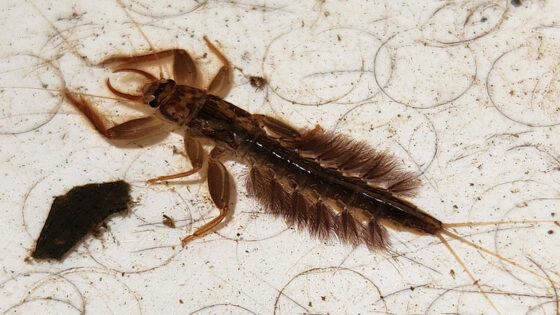
Bugs were a boyhood hobby when he was growing up on the banks of the Red Clay Creek. They were his major at college, and they remain a focus of his life at age 47. All his other interests, such as photography, audio recording, electronics, and computers, grew out of his obsession with bugs.
That’s what brought Funk to the Stroud Center 25 years ago, nine years after the lab was founded. In his last year as an entomology major at the University of Delaware, he took a course in stream ecology with Robin Vannote, Ph.D., the founding director of the Stroud Center. Funk was so impressed with what he learned that he asked Vannote if there was a spot for him at the lab. There was, and he started work in January 1976.
His first assignment was a dream job for any aspiring 21-year-old entomologist. He was sent to Idaho for 18 months to work on the Stroud Center’s River Continuum project in the Salmon River.
Funk’s intention from the beginning was to get some experience and then go back to school to continue his education. But he became so involved — and was having so much fun with his work — that he never found time to go back.
“Any regrets?”
“Yes and no,” he said. “I always loved the ground-level work — especially in a place like this. And I was never much of a student.”
In any case, what he was learning in the field and lab was a continuing education that was hard to beat.
Over the years, his talents have involved him in just about every aspect of the Stroud Center’s operations, from studying minuscule bugs under a microscope and sampling the waters of some far-off river to troubleshooting the lab’s complex computer network, fixing the telephone system and overseeing the lab reconstruction in 1995.
Stroud Center Director Bern Sweeney and Dave Funk were both weaned on Stroud water. “We both sort of cut our teeth at the Stroud Center during the ’70s and then grew up together in the ’80s and ’90s,” said Dr. Sweeney.
“Dave was a mainstay in both the field and laboratory portions of a huge National Science Foundation-Department of Energy-funded study of 30 rivers along a natural thermal gradient from northern Florida to southern Quebec Province, which I helped direct. We spent a lot of time together in the field, both in reconnaissance of new study sites and actual sampling.
“It was during that period that I realized how specially talented he was and how committed he was to the Stroud Center’s mission. He has always been a jack-of-all-trades within the Stroud Center but differs from the usual Jack in that he masters most tasks that he takes on. He has little patience for poor quality, whether it is associated with fabricating a sampler, designing a sampling scheme, identifying an aquatic bug, etc.” said Sweeney.
“Do it right and get it right” would be an appropriate monogram on the back of his T-shirts, said Sweeney. “He is clearly a Ph.D. scientist disguised as a staff scientist. Fortunately, he chose to make a career of it here and bring his talents to bear on issues at the Stroud Center.”
Dead Creek
If there’s a distinction between his work and hobbies, it’s that at work, most of the bugs he studies are aquatic, while terrestrial insects are what he photographs, tape records, and documents in his spare time. Ironically, when he first developed his interest in butterflies and moths, there were no bugs or fish in the Red Clay Creek.
“The Red Clay Creek was basically dead. I grew up thinking that fish lived only in the oceans,” said Funk.
Butterflies came first, then moths. By the time he got to college he was specializing in tiny lepidoptera, the zoological order which includes butterflies and moths.
Among other things, he is working on what may be the nation’s — and possibly the world’s — first field guide of katydids and crickets, complete with a CD of their calls and songs. His photographs of mayflies and other insects have been published in a variety of magazines, from the National Wildlife Federation’s “Ranger Rick” and the Xerces Society’s “Streamkeepers” and “Wings” to “Scientific American” and “Natural History.”
One hobby that may not be directly related to his work is his passion for mountain biking. That’s what he does during his lunch hour when he tears through the Stroud family’s surrounding woods in preparation for three-hour weekend races. When he gets back from his lunchtime training rounds, he plunges into the nearby stream “to cool off” — a practice that has raised the eyebrows of his colleagues who see him dashing into the stream even in the snowiest days of midwinter.
“Without exception?”
“Well,” said Mr. Funk, “If I have to break the ice to get in, I think twice.”
New Project
76 Miles of Buffers
Stroud Water Research Center is overseeing a federally funded project to plan the restoration of riparian (streamside) buffers along approximately 50 miles of the Red and White Clay Creeks in southern Chester County.
Another 26 miles of buffers are planned for the Tulpehocken River, which runs through Lebanon and Berks Counties into the Schuylkill River.
The project got under way this summer, and to date about 10 miles of stream buffers are in various stages of completion.
Native landscape designer Jessie Farrell will plan and coordinate the project for the Stroud Center. Ms. Farrell, whose landscape design firm, Taproot, is based in southern Chester County, will work with landowners to plan, fence (where necessary), plant, and manage the riparian buffers.
The funding, which comes through the Natural Resources Conservation Service, will pay 75 percent of fencing and planting costs, with the landowner contributing the remaining 25 percent.
Once landowners have signed on, Ms. Farrell said, she will plan the buffer, walk them through the installation phase, help them choose the plants, demonstrate planting methods, and be on-site on planting day. She plans to revisit each site again a year after the initial planting.
The amount of planting that needs to be done and the width of the buffers depend on existing conditions and the terrain. Open stock grazing fields will have to be fenced. The buffers, in the form of trees, shrubs, and grasses, are planted to filter sediment and nutrients from stormwater runoff. Stroud Center research has shown that wooded streams are also more efficient in processing pollutants that get through to the waterways.
One of the sites now in the planning and planting phase is the tributary of the East Branch of the Red Clay Creek that runs through the Willowdale Steeplechase course in East Marlborough Township. Because of its accessibility, the Stroud Center hopes to use the site to educate the public about stream buffers and plans to hold meetings this fall for landowners and others interested in the project.
River Blindness
African Story with a Happy Ending
At a time when the news out of Africa is overwhelmingly negative, this year’s Joan M. Stroud Lecture focused on an inspiring success story.
River blindness, the scourge of West Africa for centuries, was the subject of the talk by Vince Resh, professor of entomology in the Department of Environmental Science, Policy and Management at the University of California, Berkley.
In addition to his teaching, Prof. Resh also advises 11 African countries for the United Nations’ World Health Organization. He specializes in river sustainability and population resettlement of rivers freed from onchocerciasis, the scientific term for river blindness.
Mr. Resh’s connections with the Stroud Center include his involvement in the doctoral program training of two of our research scientists, Denis Newbold, Ph.D., and John Jackson, Ph.D. — “Both of whom happen to be among his best students,” said Director Bern Sweeney. “It looks like he trains them, and we put them to work.” He also shares with Bern active involvement in the North American Benthological Society. Dr. Resh is a former president of the society, and Dr. Sweeney is the current president.
In his lecture, Mr. Resh described the horrific history of the disease that caused human blindness in more than 10 percent of the adult populations of affected areas. Transmitted by blackflies, onchocerciasis led to the abandonment of the most fertile river valleys of West Africa, which Dr. Resh described as the poorest region in the world.
The United Nations launched a massive economic development plan to control the disease in 1975. Mr. Resh said river blindness has been eliminated throughout most of the affected regions by a combination of controlling the blackfly carriers in the rivers and treating the parasites in humans.
This public health success story also resulted in new food production in a region that supports about 17 million people, he said, adding that sustainability of further resettlement of the valleys remains a challenge.
He also spoke about the ecology of the affected rivers, the environmental consequences of the control program, and the sociological and geopolitical implications of population resettlement in the region.
Dr. Resh, who is the author of about 250 scientific articles, has conducted research in rivers throughout the world. He was the director of the University of California’s Gump Research Station in Moorea, French Polynesia, from 1996 to 2001.
He won the first teaching award in natural resources in 1990 and the Berkeley campus’ Distinguished Teacher Award in 1995.